This is a personal history of my relationship with the sandbox video game Minecraft and its ever-expanding world of mods. From the enchantment of discovery in my early teenage years to the present-day rediscovery of learning through simulated engineering, Minecraft has remained a time capsule, a quiet ghost that whispers memories of my childhood. In this project, I explore how a digital object, often dismissed as mere entertainment, becomes a medium of memory, self-making, and knowledge-building.
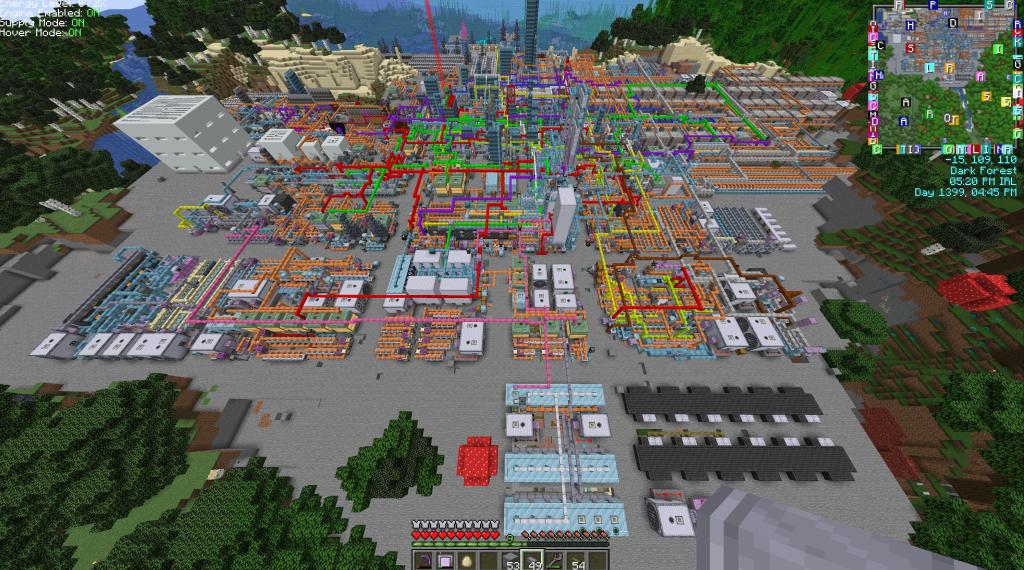
Pic1: An Automated industrial assembly line
2. Hiatus and Return: Rediscovering the Unfinished World
As I grew older and entered junior high school, life inevitably became more crowded. The hours I once spent in blocky landscapes were gradually overtaken by test prep, deadlines, and an ever-expanding sense of responsibility. Minecraft drifted into the background—not with a bang, but with a quiet fading. The icon on my desktop remained untouched for weeks, then months. Occasionally, I would hover my mouse over it, hesitate, then double-click something else instead.
But the game never really left. It lingered—not on the screen, but in the periphery of my thoughts, like a house I used to live in, still intact somewhere, waiting. There was always a faint echo, a soft whispering during idle moments: go back, explore what you left behind. Hearing a certain ambient track, or seeing a cube-shaped object in real life, could instantly conjure the image of a redstone circuit or a skybridge I once tried and failed to complete.
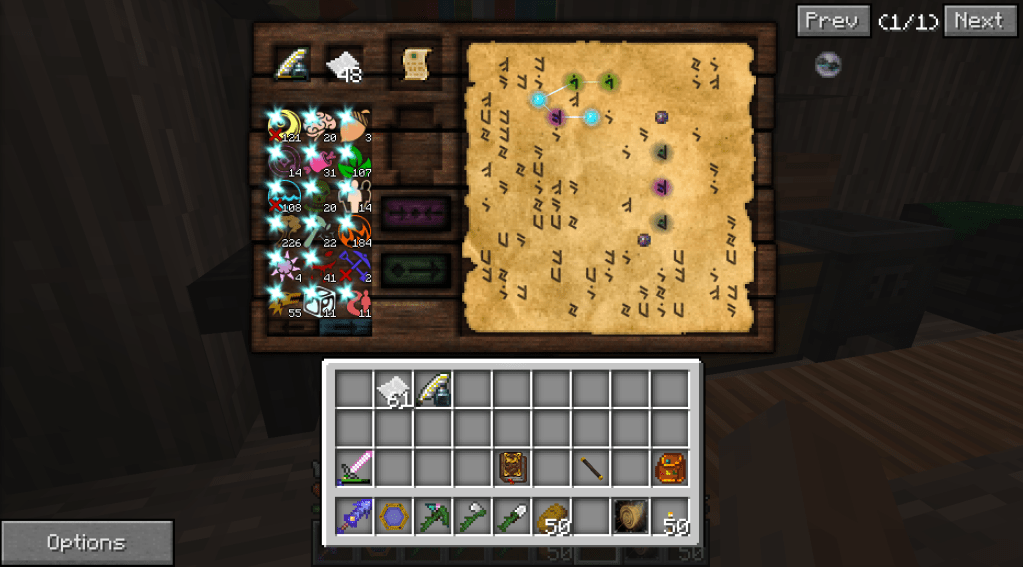
This low hum grew louder each time I found myself with unscheduled time—summer vacations, long weekends, or even late nights when I couldn’t sleep. I began returning to the game, tentatively at first. But something had changed. My playstyle was no longer about carefree exploration or spontaneous construction. Instead, I found myself drawn back to the very mods that had once confused me—IndustrialCraft, GregTech, Thaumcraft, BuildCraft. Once symbols of mystery, these mods now looked like puzzles I could finally solve. As my education progressed, and I learned more about real-world engineering, chemistry, and ecology, I realized that many of the systems in those mods were not just fantastical—they were grounded in actual scientific logic. What once felt like fantasy now resonated with familiarity.
This shift revealed a surprising turn in the object’s biography—a different regime of value. Minecraft was no longer simply a game. It became a medium through which I practiced systems thinking, modular design, and even a sort of gamified research. It blurred the line between play and learning, between memory and method. In this phase, I wasn’t just remembering childhood; I was, in a sense, collaborating with my past self—finishing what he had started, and understanding what he couldn’t.
And yet, nostalgia remained. The more I dove into complex automation systems and optimized reactors, the more I appreciated the contrast between my present and past engagements. The ghost of the boy who once clumsily wired redstone torches into nonsensical loops hovered over my now-efficient build plans. But this ghost didn’t haunt me; it accompanied me, as a quiet reminder that learning is a cumulative, recursive process. We often come back to what we once loved, but with new eyes, new tools.
Perhaps the most telling moment of this return was when I rebuilt an old, half-finished structure I remembered from a save file nearly a decade old. I didn’t change its design. I didn’t improve it. I simply rebuilt it as it was—impractical, awkward, sentimental. It felt like lighting a candle for a previous version of myself. In that moment, I wasn’t just playing; I was remembering, repairing, and respecting. It’s like continue to write about my Jibunshi, which bridges me back to my childhood.
Over the years, I’ve tried to recommend Minecraft to others—friends, families, classmates. I’ve shared screenshots, explained mods, even offered to help install them. Some liked it; most didn’t quite see what I saw. They played for a few hours, then logged off. For a long time, I found this mildly disappointing. Now I understand: they couldn’t. Because what they were playing wasn’t my Minecraft—not the version haunted by half-built towers, obscure modpacks, and redstone circuits tangled like childhood dreams.
This isn’t just about taste. It’s about inalienability, the idea that certain things—though technically shareable or tradable—resist being detached from the person who holds them. As anthropologist Annette Weiner has argued, inalienable possessions are not valuable because they can be exchanged, but because they can’t. Their meaning is so bound up with personal memory, identity, or obligation that any attempt to separate them feels like a kind of loss.
My Minecraft world—especially the save files I’ve carried across computers for over a decade—is one such object. It can be copied, zipped, uploaded, but it can’t be transferred. Its value is not in its graphics or gameplay, but in the invisible layers of life it has stored: how I once rage-quit after falling into lava, how I once spent an entire afternoon digging tunnels for no clear reason, how a single obsidian block reminds me of a vacation where I played on a my grandpa’s laptop. These aren’t stories I ever wrote down. They are encoded into the rhythms of the game, and into my muscle memory.
To lose this world would be to lose more than a set of files. It would be to lose an archive of growing up, a strange little corner of my identity that has survived every operating system I’ve used since childhood. It may look like just another sandbox game to someone else—but to me, it is un-exchangeable, unreplicable, and unshareably mine.
Pic2: A sorcery related mod
Rediscovery as Knowledge: Learning Through Play, Remembering Through Systems
The older I grew, the more I began to see Minecraft not as a game I had outgrown, but as one I had yet to fully understand. What once served as a playground for imagination began to resemble something more intricate—a scaffolding for learning. During high school and especially university, I found myself returning again and again to the world of modded Minecraft, not in search of nostalgia alone, but in search of systems.
I began with the mods that had once baffled me and, quite surprisingly, I started grasping their inner logic. I began drawing diagrams of resource flows, building self-regulating production chains, simulating thermodynamic processes or managing digital storage. Some mods mirrored principles I was studying in school: automation, energy conservation, even genetic breeding systems. I realized I wasn’t just playing anymore—I was testing hypotheses, experimenting, debugging. The game had transformed into an open-ended lab where failure was cheap and curiosity rewarded.
What surprised me most was how the same game I once played for fun began to take on a completely different meaning. In the early days, it was about exploring, building, and the thrill of discovery. But when I returned to it years later, something had changed—not just in the game, but in me. I was no longer interested in simply building large structures or collecting rare items. Instead, I found myself fascinated by the systems hidden beneath the surface: how machines processed resources, how circuits carried logic, how different components fit together to create something greater than their parts. I started drawing diagrams, planning out supply chains, and even troubleshooting problems the way one might in a real lab or workshop. The game had become a space where I could experiment freely, think in systems, and learn by doing. It had quietly shifted from being a playground of imagination to a toolkit for structured thought. That shift didn’t happen all at once—it unfolded slowly, as I realized that what I was doing wasn’t just playing anymore. It was learning, remembering, and building something that somehow connected both who I was and who I was becoming.
In retrospect, I think what drew me back was not just the surface complexity of these systems, but the way they gave shape to a very specific desire: the urge to learn without the fear of being measured. Within this sandbox, there were no grades, no deadlines—only problems to solve and puzzles to unlock. It was a space where knowledge could be tactile, iterative, and safe. Even now, when I open a new modpack, I feel that same sense of thrill that leads me to deconstruct a system with what I am gradually learning. I spend days constructing a machine just to see it work once. I scroll through wikis, compare ratios, write plans in notebooks. In those moments, I realize that Minecraft has become not just a vessel of memory, but an engine of thought. A modest digital object, now suffused with layers of memory, skill, and aspiration.
This isn’t simply “learning through play.” It’s something more recursive, more personal. In the design of a functioning reactor or the optimization of a logistics system, I often feel like I am answering a question that my younger self once asked—just without the words.
Sometimes I wonder what would happen if I lost it all.
Not just the game itself—I could always reinstall that. I mean the worlds I’ve built, the save files tucked away in old hard drives, the intricate machines left running in half-finished underground labs, the scattered chests full of unorganized blocks. I wonder what it would feel like to lose the long corridors I once dug without purpose, or the strange towers I built simply because I felt like stacking things high into the sky. I’ve never backed them up in any serious way, and yet I carry them with me, as if they were always just a few clicks away.
If I were to lose them, I wouldn’t cry. But I would feel something heavy and hard to name—something close to grief, but softer. Like losing a version of myself I can no longer visit. Because these virtual spaces aren’t just constructions of code. They are imprints of moods, echoes of moments when I was too young to name what I was feeling but still found ways to express it—block by block.
And yet, maybe that’s the point. I’ve never truly owned this game, not in the way we usually think of ownership. I’ve lived with it. I’ve grown with it. I’ve left it behind and returned to it again and again. It has waited for me, quietly, with no demands—only possibilities. To live with something like that is not to possess it, but to accept that it holds a part of you, even if you can’t explain exactly what part that is.
I don’t play every day anymore. Sometimes I go months without opening it. But it remains there—anchored in some quiet corner of my life, always ready to be returned to. It’s not just a game I used to play. It’s a landscape I remember, a tool I’ve come to understand, and a silent witness to the long, looping path I’ve taken through childhood, curiosity, and becoming.
If I lost it, I would move on. But if I live with it, I remember who I was—and who I still am.
—Thank you for reading—
Bibliography
Moran, Joe. “History, Memory and the Everyday.” Rethinking History, vol. 8, no. 1, 2004, pp. 51–68. Taylor & Francis, https://doi.org/10.1080/13642520410001670929.
Nozawa, Shunsuke. “Life Encapsulated: Addressivity in Japanese Life Writing.” Language & Communication, vol. 46, 2016, pp. 95–105. Elsevier, http://dx.doi.org/10.1016/j.langcom.2015.10.004
Weiner, Annette B. “Inalienable Possessions: The Forgotten Dimension.” Inalienable Possessions: The Paradox of Keeping-While Giving, University of California Press, 1992, pp. 23–43. JSTOR, http://www.jstor.org/stable/10.1525/j.ctt1ppcbw.6.

 MEMORY REBUILD